
By Nathen Kemper, Owner of Windows For Life. Over 16 years installing and selling replacement windows and doors across Middle Tennessee. Based in Gallatin.
You just bought a house, or you’re about to. The inspection report came back, and it’s 40 pages long with photos of things you didn’t know existed. GFCI outlets. Flashing. Something about a “moisture reading at the south elevation.”
Here’s the thing nobody tells you: inspection reports list everything, and most of them color-code it. Green looks good, yellow is a future concern, red needs attention. What they don’t tell you is the order. When your report has fifteen items marked “needs attention,” it doesn’t say which one to spend money on first. A missing outlet cover and rotting wood around a window can both show up red, sitting two lines apart like they’re the same size problem. They’re not.
I’ve spent over 16 years working on homes in Middle Tennessee. I sell windows and doors for a living, and even I’ll tell you that most of what’s on that report can wait. A few things can’t.
The whole system is three rules, in order:
Rule One: anything that lets water in gets fixed first. Rule Two: the systems that make the house livable come next. Rule Three: everything else is an improvement on your timeline, not an emergency.
Every item on your report falls under one of these. Here’s what you need to fix first in your new home after receiving your inspection report.

Skip past the cosmetic stuff and hunt your report for these words: moisture, water staining, soft wood, deteriorated sealant, failed flashing, wood rot, elevated moisture reading.
Those line items outrank almost everything else on the report, no matter where the
inspector put them. Same goes for anything flagged as foundation or structural movement. That sits at the top of the list right alongside water, and often because of water, since poor drainage and moisture in our Middle Tennessee clay soil is what puts foundations in motion in the first place.
Here’s why. Water damage doesn’t wait politely while you settle in. In our Tennessee climate, wet wood soaks up rain, then summer heat dries it out, then the next rain soaks it again. Every cycle breaks the wood down a little more. This can go on for years behind your walls with no visible sign inside the house.
By the time you’d see a water stain on your drywall, the framing behind it has often been deteriorating for years. Your inspector’s moisture meter caught what your eyes can’t. Take that seriously.
And know this: water doesn’t just come from the roof. It comes through siding, brick, flashing, and very often through and around windows and doors that were installed or sealed poorly. If your report flags soft wood at a window sill or door frame, that’s not a window problem. That’s a water intrusion problem, and it belongs at the top of your list.
One more thing about that house you just bought. If the previous owner replaced windows a few years back, a bad installation may not have shown itself yet. Poorly sealed windows can look perfect for a year or two before the seals fail. The report’s moisture readings around openings matter more than how new anything looks.
Second tier: HVAC, water heater, electrical issues your inspector marked as safety concerns.
If the report says the AC unit is at the end of its life, believe it, and budget for it before you budget for anything cosmetic. Nobody should spend their first August in a new home sweating through a dead unit because the repair money went to new countertops.
The same goes for a water heater past its expected life. Those rarely fail politely, and when they go, they usually go with a flooded floor attached. And anything your inspector flagged on the electrical side as a safety item, like double-tapped breakers or aluminum wiring, isn’t a someday project. That’s a licensed electrician, sooner rather than later.
But here’s what most inspection reports won’t connect for you: your windows and your HVAC system are on the same team, and bad windows make your HVAC lose.
When windows leak air, your system runs almost constantly trying to hold the temperature. You pay for that twice. Once every month on the utility bill, and again in years shaved off the life of your unit, because an AC that never gets to rest wears out faster.
We did an energy audit on a house right here in Hendersonville. A couple in about 2,800 square feet, and their energy bill was running over $500 a month. The windows were in rough shape and bleeding conditioned air.
After we replaced them, their bill dropped to a little over $200 a month. Just as important, their AC stopped running around the clock. That’s one house with unusually bad windows, so I’m not promising you those numbers. I’m telling you the connection is real, and it’s money and equipment life, not just comfort.
I don’t sell HVAC. I’m telling you this because it’s the order I’d give my own family: stop the water first, make the house livable second, improve it third.
Notice Where Windows Keep Showing Up
Go back and look at what just happened. Windows appeared in Rule One, because a poorly installed window is one of the most common ways water gets into a home. Now they showed up in Rule Two, because leaking windows drive your energy bill up and grind your HVAC down.
That’s not me sneaking my product into every category. It’s the nature of the thing. Windows are one of the only items on your inspection report that sit in your walls, touch the weather on one side and your living space on the other, and affect water protection, comfort, and safety all at once.
And believe it or not, sometimes window repairs can be made. Window replacement isn’t always necessary. We’re not here to upsell you a product you don’t need. Our goal is to satisfy homeowners, solving the actual problem with the most economical scenario in mind.
The condition of your windows decides which rule they fall under. Soft wood and failing seals put them in Rule One. Drafty-but-dry puts them in Rule Two territory. Solid and sealed puts them in Rule Three, where they belong.
Here’s the good news. Once you’ve handled tiers one and two, the rest of that report loses its power over you. Dated fixtures, the deck that needs staining, and yes, windows that are aging but sealed tight and doing their job. Those are improvements. You get to do them on your timeline, with a plan, when the money makes sense.
One item that does NOT belong in this category, even though it looks small on the report: worn weatherstripping. Bad weatherstripping on a window or door is an open invitation. Water gets in. Outside air pours in, which is a big part of why your house won’t hold
temperature and your utility bill creeps up. And bugs and insects treat that gap like a front door. Weatherstripping is one of the cheapest fixes on your entire report and one of the hardest working. If the inspector flagged it, handle it early, not someday.
That’s a completely different position than reacting to damage. The whole point of the priority order is to keep items in the improvement category from ever climbing into the emergency category.
One more thing while you’re pressing: a lot of homes have windows and doors that were wrapped in metal somewhere along the way. Press on that metal too. If it’s solid and doesn’t flex, that’s a good sign. If it gives under your thumb, the wood behind it is rotten. And if you press and hear a crunch like cereal, the wood behind that metal is terribly rotten, and the wrap has been hiding it.
While you’re at it, press the baseboards in bathrooms, under sinks, and around the water heater too. Water doesn’t only pick on windows, and soft wood anywhere means the same thing.
If everything checks out, congratulations. You bought a good house. Go enjoy it.
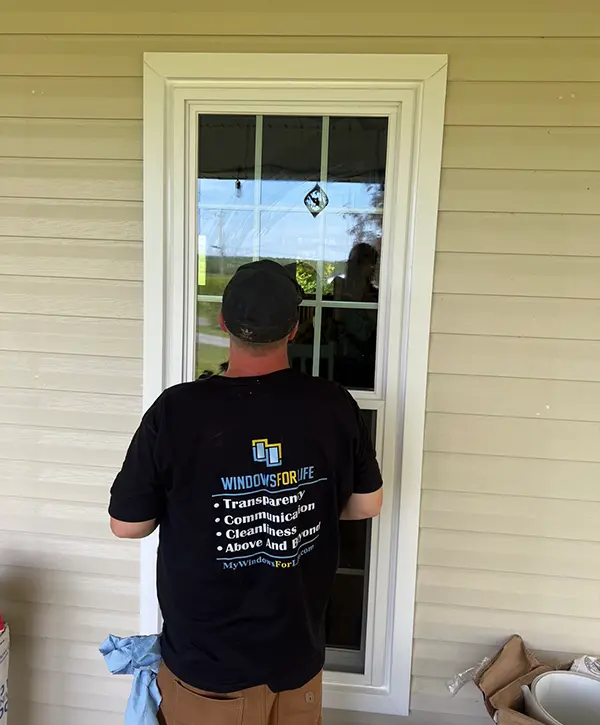
If you’ve closed on the home and it’s yours, and the inspection flagged moisture or soft wood around windows or doors that you’re still wondering about, I’ll come out and look at it for free. No charge, no obligation. I’ll tell you the truth about what you’re seeing, including if the answer is that it can wait.
Still under contract and haven’t closed yet? Give us a call anyway. We’re glad to talk through what’s on the report over the phone and help you understand what you’re looking at before you make one of the biggest decisions of your life.
Windows For Life | Gallatin, TN Call or text: 615-572-6238 mywindowsforlife.com
Serving Nashville, Hendersonville, Lebanon, Mt. Juliet, Franklin, and Brentwood.
Nathen Kemper grew up in construction and has spent over 16 years installing and selling replacement windows and doors. He owns Windows For Life in Gallatin, Tennessee, where his rule is simple: educate first, and let the homeowner decide.